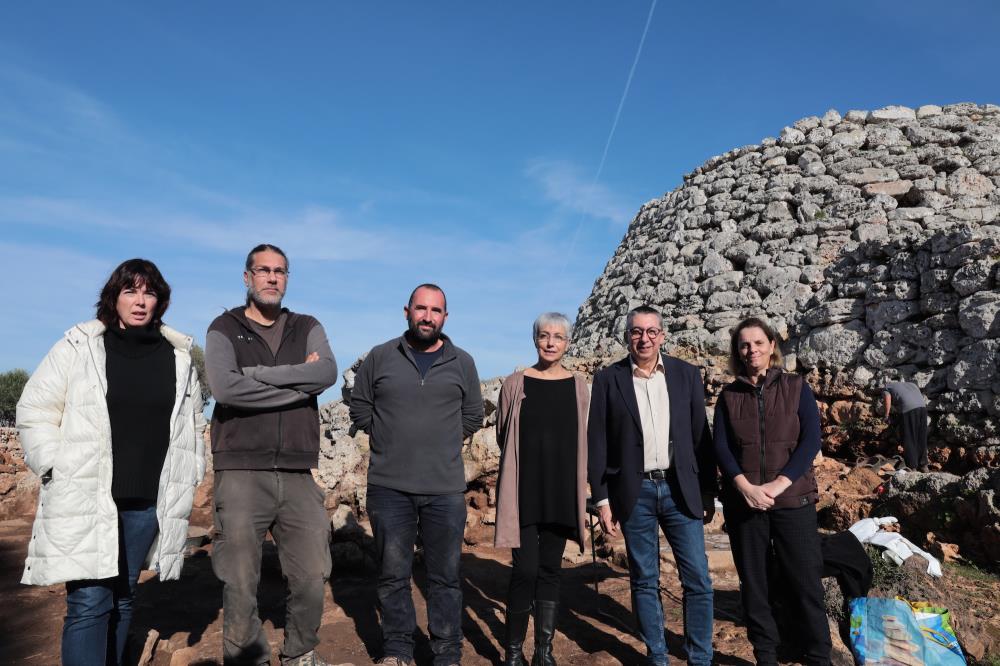
 The Cornia Nou research project ended its 16th excavation field season with the presentation today, 20 December, of the latest advances at the site itself.
The project's team of co-directors from the Associació Arqueologia i Patrimoni – comprising Damià Ramis, Muns Anglada, Antoni Ferrer and Lluís Plantalamor– were accompanied by the vice-president and conseller for Cultural Affairs, Miquel Àngel Maria; the deputy mayor and executive councillor for Cultural Affairs on Maó City Council, Conxa Juanola; and Carolina Desel, director of the Museu de Menorca.
This year work focused on excavating the exterior of the western building of the western sector Cornia Nou, where there is a large archaeological complex comprising a talayot and two monumental buildings alongside. These large buildings, which have been researched over the past 15 years, have been interpreted as centralised spaces for the administration, processing and storage of agricultural and livestock produce during the early phases of the Talayotic era (1100 to 600 BC). .
The 2022 field season served to identify a whole set of rooms, as well as the remnants of as many as three open-air combustion structures and four in the interior spaces, which could be connected with subsidiary functions ancillary to those performed inside the building.
Materials uncovered
The materials associated with the structures excavated comprise
stone tools, such as two mortars, various manual mills, hammerstones; and
bone tools, such as punches, but also
remnants of handmade ceramic containers, including a fragments of a large containers, along with other materials which may be connected with food processing.
Today researchers have found a circular
bone plug about 4 cm in diameter, with a perforation at each end. Although it is reminiscent of the stoppers of the cylindrical containers that have been found in funerary spaces such as Sa Cova des Càrritx, its function remains unknown at the moment.
Meanwhile, the adaptation work included
removal of a dry stone wall built over one of the façades of this set of rooms when the property was subdivided, and which made it more difficult to establish an understanding of the archaeological unit. Various wild olive plants which were damaging the prehistoric structures were also removed. All these tasks will serve to open up a
new space for visitors to the settlement.
The 2022 field season at Cornia Nou was made possible by funding from the Consell Insular de Menorca, through a grant for the archaeological work; the Museu de Menorca and Maó City Council, and authorisation granted by the owners of the land: the Osuna-Sard family and M.Polo.